The interpretations of Socionics dichotomies used in 15dichos mainly come from the Talanov tests, and to a smaller extent, resources by Viktor Gulenko, Ivan Romanov and Sociotype.com.
Energised by other people; have more social skills, more friends, being more proactive; higher energy levels, leading them to seek excitement and being impulsive and competitive; dislike monotony; seek new things, changes, show off and are more argumentative.
Energised by solitude; higher apathy, cautiousness and patience, while having less self-confidence; lower energy levels, preferring stability over excitement, leading to composed and collected behaviour but also being more anxious and prone to sadness; risk-averse; more concentrated and sincere.

Visionary outlook with a sense for making patterns between the past, present and potential future; idealistic; focused on ideas rather than concrete surroundings; theory over practical applications; less grounded thinking.
Present in the moment, down-to-earth and more realistic; naturally more comfortable with the physical rather than the world of ideas and thoughts; focus on practicality over theory; lack of foresight.
Logic-based, more interested in systems and structures rather than people; make logical evaluations between right and wrong; make decisions supported by facts and comparisons; less passionate and insensitive to interpersonal matters.
Feelings-based, more interested in people rather than logical solutions; follow their heart and gut; focused on ethical evaluations between good and bad; more persuasive than argumentative; focus on their own and other people’s behaviour, relationships; more empathetic.
More spontaneous, flexible and tolerant; less disciplined and punctual with negative views on norms and rules that they prefer to challenge rather than follow; more comfortable with improvisation; weaker inhibitions, focus and inner drive (leading to laziness).
More thought-through, regular and orderly; knows and follows societal norms and are aware of their responsibilities, more the type to finish work on time; controlled, methodical and organised, disliking improvisation; more prone to perfectionism and overthinking.
Naturally relaxed, more people-oriented and friendly, finding virtue in kindness, trust and altruism; dislike for violence and conflict.
Naturally ready, at times finding it hard to relax; socially more vindicative and firm, holding grudges and trust people less.
Idealists pursuing their passions, at times happy-go-lucky; focused on the emotional aspect of activities; not inclined to generalise objectiveness from experiences but tend to propose different conceptions during conflict.
Pragmatic realists that favour tangible results over theory or enjoyment; more sure of what is the best or correct way to do something; approach activities with algorhytmic phases/rituals; prefer when some harder stages are skipped by an external force (e.g. being introduced to a friend by a friend is easier than meeting someone new).
Tend to dialogue more than monologue, asking questions, sometimes just for the sake of it; affirm new information with nods or ‘mhm’s; somewhat more irritable and socially imbalanced, more the type to ask different people the same question to confirm or uncover decepit or subjectivity.
Tend to monologue more than dialogue, declaring statements, their questions sounding more rhetorical and would only ask a question when the information is genuinely needed; prefer longer speeches of self and others to shorter dialogues, listening silently when someone speaks and expecting the same from others.
More immersed in the process, preferring to single-task and work sequentially; more composed in activities but with a tendency to overcomplicate the process.
Detached from the process and more comfortable with multi-tasking; prone to switching between different activities, leaving things half-finished; the type to read only the required parts of a document/book rather than reading from start to finish.
Holding static, even steadfast, views that don’t change often; feel more confident in what they know; more focused on how things are rather than how things change (“life as a description”).
Views more prone to change, showing inconfidence in personal views or field dependance of judgement; more focused on how things change rather than how things are at a certain time (“life as a story”).
Optimistic and seeing the brighter side of things (“glass half-full”); more complimenting than reprimanding, more trusting; focused on what things are or should be.
Pessimistic and seeing the darker side of things (“glass half-empty”); more reprimanding than complimenting, less trusting; focused on what things are not or should not be.
The “getting down to business” type that cuts small-talk and focuses on the task at hand or things to get over rather than on the emotional atmosphere of the interaction; rarely offers or wants comfort or sympathy, rather wanting and offering concrete solutions; usually replaces emotiveness with emotional ‘anchors’ that support their inner feelings, like an object of comfort or a trusted person.
The emotive type that cares more about how an interaction feels rather than what is discussed, more comfortable with small-talk and feeling it’s missing when omitted; want and offer comfort and sympathy more than concrete solutions; emotionally latch onto other people in a conversation, and when alone, their inner feelings are more self-regulated, hence not as needy of emotional anchoring.
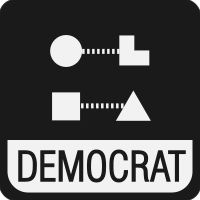
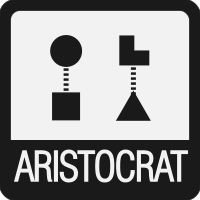
Accepting of and accomodating to other people’s views, in teams often pooling opinions and forming a consensus; see people more individually by their personal qualities rather than by a label or group they belong to, not inclined to generalise group features.
Defending against and rejecting wild flights of fancy; see people less individually, more by what groups they belong to and the shared traits rather than seeing people as separate selves, inclined to generalise group features and seek circles defined by their valued qualities.
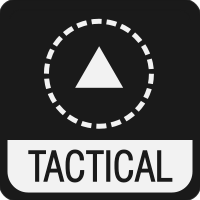
Focused on the task at hand, not attempting to prepare for the future (“you cannot prepare for everything”, “you don’t know what tomorrow will be like”); solutions are focused on a specific problem rather than the broader context; more narrow-minded.
Prefer to see the broader picture and seek solutions that solve a certain problem more generally and broadly, focused on future-readiness; think and stress more about the future (“it’s best to prepare in advance”).
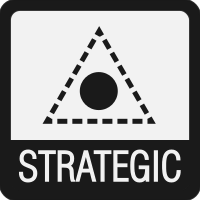
Leaves end goals unsettled (as a vague vision), focusing more on the methods used, making them more flexible; expands options; more easily adapts to external changes; usually enjoys the process more than the result, may seem to Strategists like “they don’t know what they’re doing”.
Has (or needs) a clearer end goal that they defend, defining methods to fit goals and not vice-versa; dislikes being forced to deviate or compromise on goals, less flexible and more prone to external changes; “the whole task is defined by the end result – bad result means the overall activity was bad”.
Resource-preserving, not going above what they believe they can achieve and give up on things they believe they can’t do; narrower comfort zone; easily aware of interests boundaries of themselves and others.
Idea/dream-preserving, believing ideas and dreams are sacred and shouldn’t be given up on, and it’s the resources that are malleable, not abandoning their ideas because of inadequate resources, but rather working towards improving those resources; broader comfort zone.